
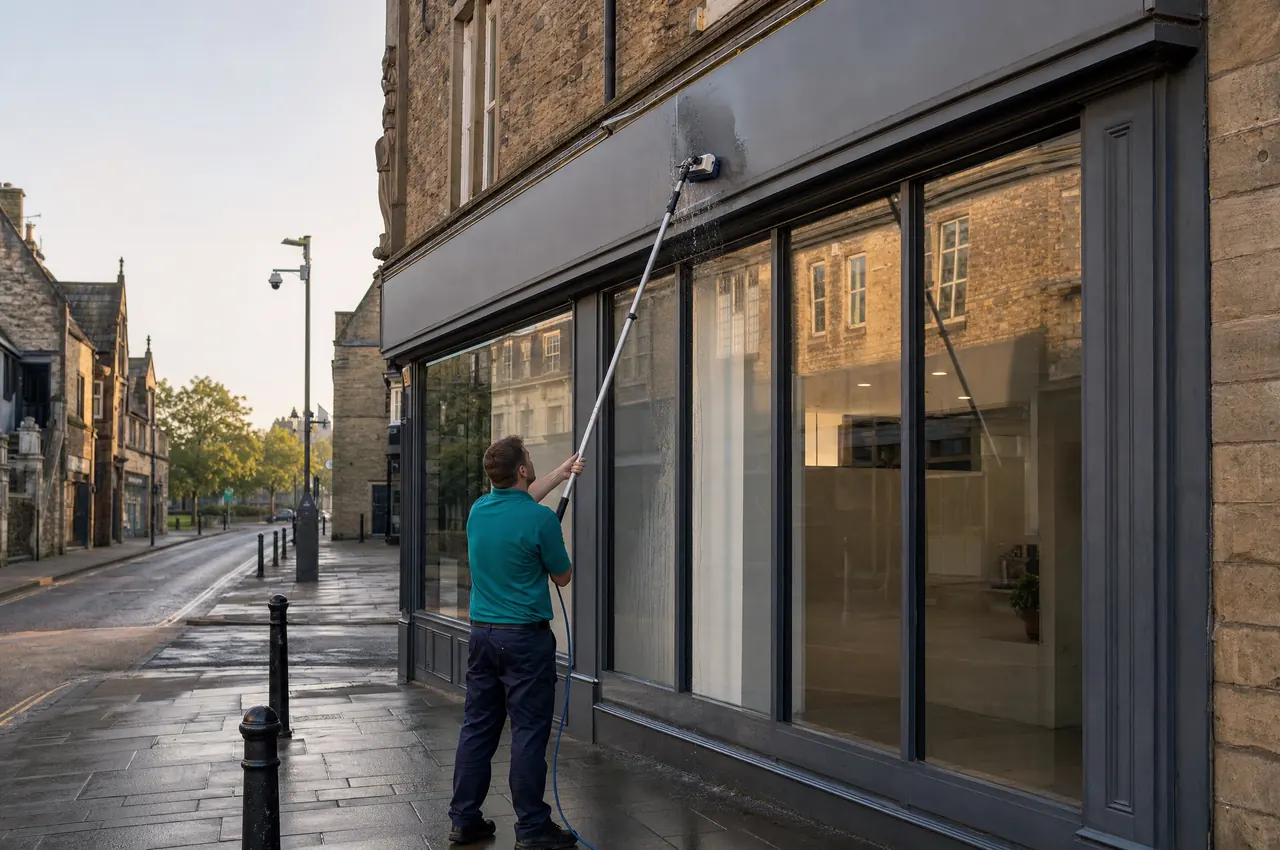
Shopfront & Signage Cleaning in County Londonderry
County Londonderry property managers, landlords and businesses use us for shopfront & signage cleaning that is planned properly: survey, test panel, method statement, then the full clean.
Shopfront cleaning keeps the whole frontage of a shop or unit clean — glazing, frames, fascia signage, canopies, shutters and stall risers — usually on a regular weekly or monthly round. A clean frontage is the first thing customers see, and regular cleaning stops traffic film and grime building up on signage and frames.
Shopfront & Signage Cleaning across County Londonderry
Mild, wet weather encourages algae and lichen on render and north-facing walls — so in County Londonderry we see a lot of red brick terraces, rendered homes, sandstone civic buildings and modern clad offices. Each gets its own method and a test panel first.
- Shutters are washed so grime is not rolled up into the shutter box.
- Chewing gum, stickers and tape residue are removed from glass and entrances.
- Pure water and soft brushes are safe on illuminated signs, vinyls and powder-coated frames.
- Multi-site rounds can cover every branch in a town or region on one schedule.
Shopfront & Signage Cleaning prices in County Londonderry
Typical rates in County Londonderry are around £1.8–£4.5 per m² of facade + VAT. A job of about 200 m² of facade would typically be £580–£1,440 + VAT including access.
Towns we cover in County Londonderry
FAQs
How often should a shopfront be cleaned?
Most high-street shops have the glass cleaned weekly or fortnightly and the full frontage — signs, canopy and shutter — monthly or quarterly.
Can you clean illuminated signs?
Yes. We use pure water and soft brushes, keep water away from electrics, and can isolate signage with your permission before cleaning.
Do you cover all of County Londonderry?
Yes. We carry out shopfront & signage cleaning across County Londonderry, including Londonderry County Borough, Derry, Coleraine.
Book a free facade survey in County Londonderry
Test panel, method statement and a fixed written quote — no obligation.