
Facade cleaning FAQ
Straight answers to the questions we are asked most.
What is facade cleaning?
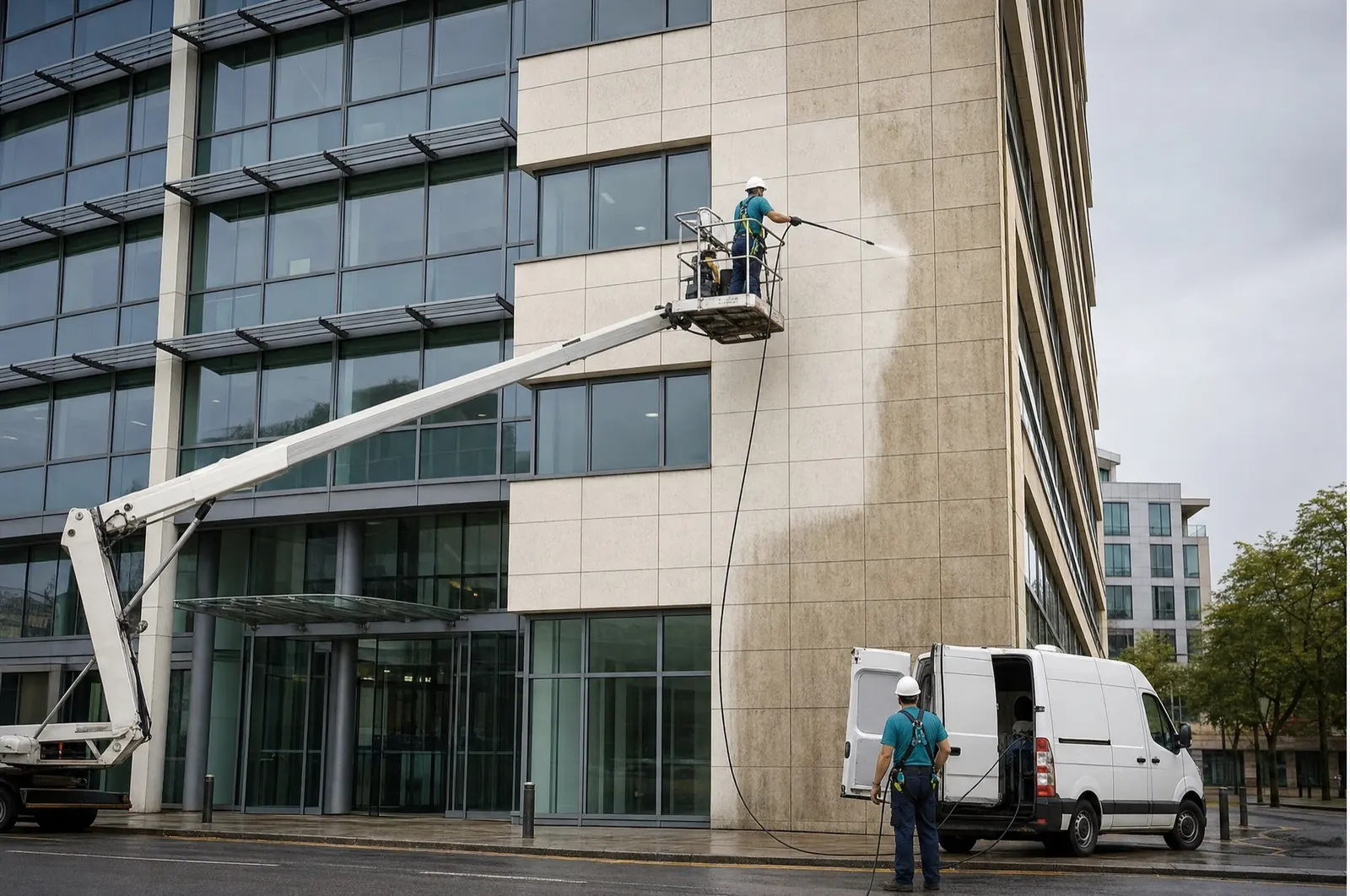
Facade cleaning is the professional cleaning of a building's external walls — brick, stone, render, cladding and glass — to remove soiling, algae, carbon, staining and graffiti. The method is chosen for each material so the surface is cleaned without damage.
How much does facade cleaning cost in the UK?
As a guide, most facade cleaning costs £4–£30 per m² depending on the material and method: pressure washing robust surfaces sits at the low end, render soft washing around £6–£12/m², and conservation stone cleaning £12–£30/m². Access (towers, MEWPs, rope access) is added per day. Use our guide-price tool for a range for your building.
Do you work on listed and heritage buildings?
Yes. We use conservation-grade steam (DOFF) and gentle vortex (TORC) cleaning, test-clean first and can supply method statements to support listed building consent. Check consent requirements with your local conservation officer before work.
Can you clean without scaffolding?
In most cases, yes. Water-fed poles reach about 20 metres, MEWPs cover most low and mid-rise buildings, and rope access reaches high-rise elevations, all without the cost of scaffolding.
Do you cover my area?
We work across England, Scotland, Wales and Northern Ireland. Find your county and town on our areas page, or enter your postcode in the guide-price tool.
Is the run-off water controlled?
Yes. We use biodegradable products, cover drains where needed and use wet vacuum recovery on sensitive sites so dirty water does not enter surface water drains.
How long does a facade clean last?
Most facades stay visibly clean for three to five years. Render and north-facing walls re-green faster, typically two to three years, unless a biocide or protective coating is applied after cleaning.
Will pressure washing damage my brickwork?
Not when it is set up properly. We test first and only use pressure washing on surfaces strong enough for it. Soft, historic or lime-pointed brickwork is cleaned with low-pressure steam instead.
Why has my render gone green?
Render traps moisture, especially on north-facing and shaded walls, and airborne algae and lichen spores settle and grow. Silicone render is not immune — the growth sits on the surface and needs killing, not just washing.
What is DOFF brick cleaning?
DOFF is a superheated steam system that cleans at around 150°C and very low pressure. Heat breaks down carbon, algae and paint, so very little force is needed — that is why it is favoured for soft and historic brick.
Do I need consent to clean a listed building?
Often, yes. Cleaning that changes a listed building's character can need listed building consent. Check with your local planning authority's conservation officer; we can supply a method statement and test-panel photographs for the application.
How often should cladding be cleaned?
Many coating manufacturers specify cleaning every 6 to 12 months in urban, industrial or coastal areas, and at least yearly elsewhere, to keep the finish warranty valid. We can set up a planned programme.
Can you use our building's cradle or BMU?
Yes, where it has a current thorough examination and our operatives are trained on it. If not, we provide rope access or MEWP access instead.
How often should commercial windows be cleaned?
Shopfronts usually weekly or fortnightly, offices monthly to quarterly, and blocks of flats quarterly. We can set a schedule and send a reminder before each visit.
Is rope access safe?
Rope access has an excellent safety record when run to recognised industry methods: every technician uses two independent ropes, work is supervised, and anchors are tested before use.
How quickly can you remove graffiti?
We aim to attend offensive graffiti as a priority, often within one to two working days depending on location. Planned contracts can set a fixed response time.
Do coatings stop walls breathing?
The masonry treatments we use are vapour-permeable — they stop liquid water getting in while letting water vapour out, which is essential for brick and stone.
How often should commercial gutters be cleared?
At least once a year, ideally after leaf fall in late autumn. Buildings near trees often need two visits a year.
Will roof cleaning damage my tiles?
Not with the right method. We remove moss by hand first and use low pressure only on surfaces that can take it. Fragile or old roofs get a biocide-only treatment.
How often should a shopfront be cleaned?
Most high-street shops have the glass cleaned weekly or fortnightly and the full frontage — signs, canopy and shutter — monthly or quarterly.
Is pigeon fouling dangerous?
Dried droppings can carry bacteria and fungi, so clearance is done with respiratory protection, damping down and disinfection rather than dry sweeping.
Book a free facade survey
Test panel, method statement and a fixed written quote — no obligation.