
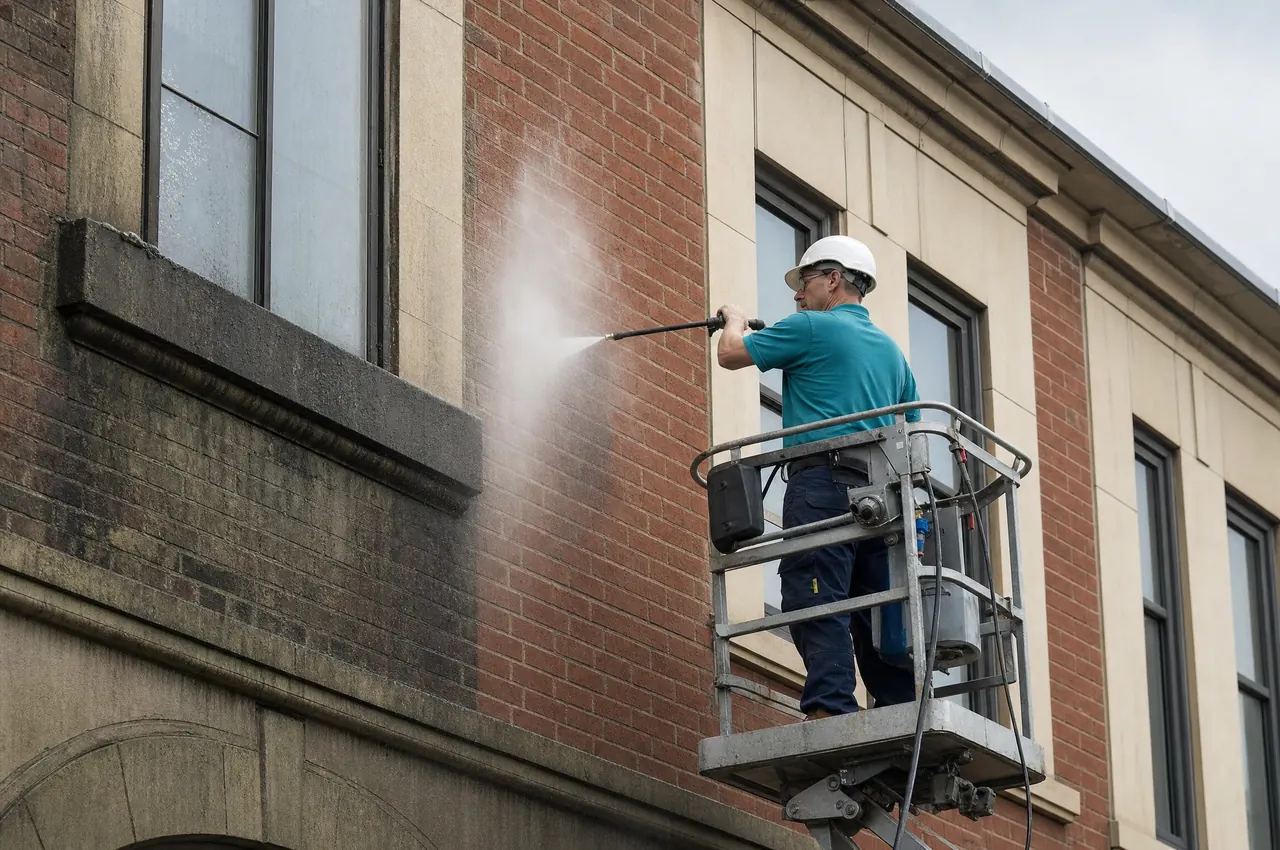
Pressure Washing in Wrexham
Pressure Washing across Wrexham, Wrexham: safe access, controlled run-off and dated before-and-after photos of every elevation we clean.
Pressure washing (jet washing) cleans hard, durable building surfaces with a controlled water jet, hot or cold, often combined with a pre-applied detergent. On facades it suits robust materials — concrete, engineering brick, blockwork and plinths — where the pressure and nozzle can be set so the surface is cleaned without being cut or opened up.
Pressure Washing across Wrexham
High rainfall means green growth returns faster on render and shaded masonry — so in Wrexham we see a lot of stone-built terraces, rendered and painted villas, chapels and modern business-park units. Each gets its own method and a test panel first.
- Run-off is managed with drain covers, booms or vacuum recovery where the site requires it.
- Hot water (up to 150°C) shifts grease, chewing gum and oily carbon deposits without harsh chemicals.
- Detergents are biodegradable and dwell before rinsing, so less pressure is needed to lift the dirt.
- Soft or historic brick, lime mortar and render are moved to steam or soft-wash methods instead.
Pressure Washing prices in Wrexham
Typical rates in Wrexham are around £3.7–£9.3 per m² of facade + VAT. A job of about 200 m² of facade would typically be £980–£2,420 + VAT including access.
Towns we cover in Wrexham
FAQs
Will pressure washing damage my brickwork?
Not when it is set up properly. We test first and only use pressure washing on surfaces strong enough for it. Soft, historic or lime-pointed brickwork is cleaned with low-pressure steam instead.
Is hot water better than cold?
For oily soiling, gum, traffic film and grease, yes — heat does much of the work, so lower pressure can be used. For simple dirt and green growth, cold water with a detergent is often enough.
Do you cover all of Wrexham?
Yes. We carry out pressure washing across Wrexham, including Wrexham, Rhosllannerchrugog, Brymbo.
Book a free facade survey in Wrexham
Test panel, method statement and a fixed written quote — no obligation.