
Commercial Window Cleaning in Shropshire
Our commercial window cleaning teams work across Shropshire and the wider Shropshire area, cleaning facades safely around occupied buildings with minimal disruption.
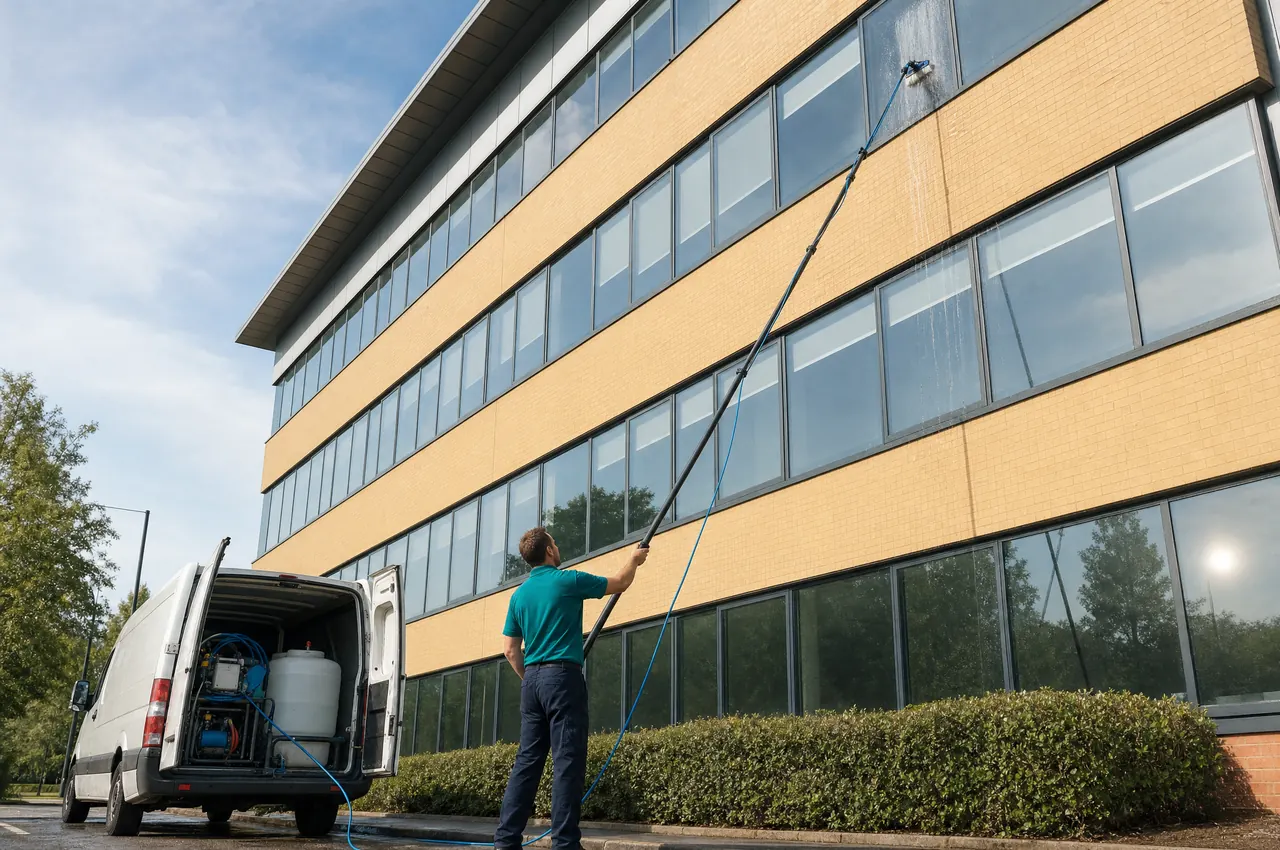
Commercial window cleaning is the regular cleaning of external (and often internal) glazing on business and residential buildings, usually by water-fed pole, which uses purified water and a brush on an extending pole to clean glass safely from the ground up to around 20 metres. Above that height, cleaning moves to MEWP, cradle or rope access.
Commercial Window Cleaning across Shropshire
Traffic film and algae on north-facing elevations are the common problems — so in Shropshire we see a lot of red brick Victorian and Edwardian buildings, 1960s concrete, rendered estates and modern clad warehouses. Each gets its own method and a test panel first.
- Water-fed poles keep operatives on the ground — the safest way to clean upper windows.
- Regular rounds can be weekly, fortnightly, monthly or quarterly to suit the building.
- Frames and sills are cleaned on every visit, not just the glass.
- Internal glazing, partitions and atria can be added to the same visit.
Commercial Window Cleaning prices in Shropshire
Typical rates in Shropshire are around £1–£3 per m² of glazing + VAT. A job of about 400 m² of glazing would typically be £650–£1,800 + VAT including access.
Towns we cover in Shropshire
FAQs
How often should commercial windows be cleaned?
Shopfronts usually weekly or fortnightly, offices monthly to quarterly, and blocks of flats quarterly. We can set a schedule and send a reminder before each visit.
How high can a water-fed pole reach?
Typically up to about four to six storeys, around 20 metres, depending on the building and ground conditions. Above that we use MEWPs, cradles or rope access.
Do you cover all of Shropshire?
Yes. We carry out commercial window cleaning across Shropshire, including Telford, Shrewsbury, Loughton, Wellington, Oswestry and surrounding areas.
Book a free facade survey in Shropshire
Test panel, method statement and a fixed written quote — no obligation.